The Captured City is catching the train
Why Wynberg and the inner city are showing us Cape Town’s future, and why Constantia isn’t (yet)
Leif Petersen and Andrew Charman
In 2010 we bought a property on a Mixed Use zoned street in central Wynberg and made it our office. That same year we began the first of three censuses of every business in Delft South. For a decade we thought of our research as being about places elsewhere: townships we visited, mapped and came home from.
Our street has taught us otherwise. Across the road, a drug-selling operation that was there before us has outlasted every policing campaign since. Next door, a property zoned for a single house has become an informal settlement. A few hundred metres away, at the station interchange, street traders work on land managed by different authorities under different rules. In practice, as our 2015 study for the City found, they largely regulate one another.
The formal city, the informal city and the renegade economy sit on one block. We no longer think this is an anomaly. We think it is a preview.
What a decade of counting tells us
In 2010/11 we counted 879 micro-enterprises in Delft South, in an area where the City officially recognised fewer than 150 businesses. By 2015 the number had roughly doubled. By 2020 it had fallen to 1,158, and only 71 of those operators had been encountered in either earlier wave.
The losses were among survivalists: women selling food from their homes, small shebeens, hawkers. The gains came from spaza shops tied into wholesale networks and from capital poured into rental flats. In 2010, gangsters pestered shopkeepers for cigarettes. By 2020, businesses were making weekly or monthly protection payments.
The state’s response has barely changed. In 2013 we described “enforced informalisation”: police raids that pushed shebeens deeper underground instead of into licensing. In Delft, only 13 of 117 liquor outlets held a licence. The 2024 spaza registration drive repeated the pattern. It demanded title deeds, zoning certificates and tax clearance, the very documents our research shows most township businesses cannot produce. The operators best equipped to comply were the well-capitalised networks, not the survivalists.
Informality is not receding. It is reorganising: more commercial, more mobile, and more coercively governed.
Four cities
Reflecting on our time researching the township economy, but also given some distance since our research was published, we now consider two open questions. 1. Will the state adapt its regulation to the economy that actually exists?; and 2. Will informal markets be governed by embedded social institutions, such as reciprocity, community legitimacy and local business pioneers, or by extractive and coercive actors? The answers produce a matrix of four possible South African cities for 2050;
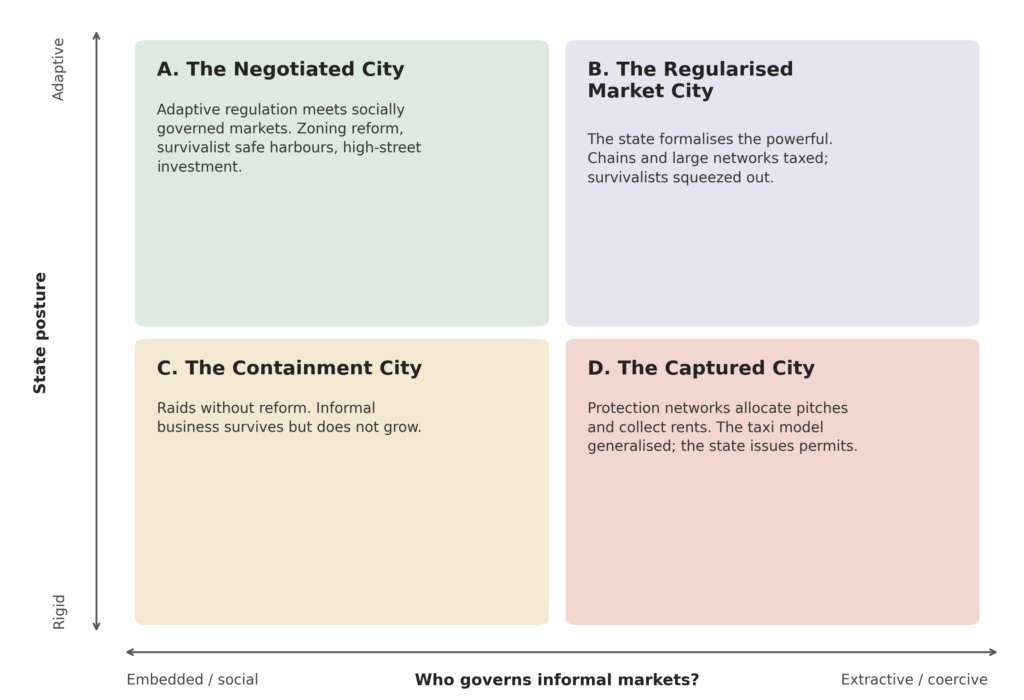
In the Negotiated City (A), an adaptive state meets socially governed markets. Zoning is reformed, survivalists get a legal safe harbour, and high streets densify. Windhoek’s Eveline Street, where enterprises doubled and licensed businesses rose from 10 to 64 after the corridor was rezoned, shows it can be done.
In the Regularised Market City (B), the state adapts but formalises the powerful. Chains and large networks enter the tax net, and survivalists are squeezed out.
In the Containment City (C), raids continue and reform never comes. Informal businesses survive but do not grow. This was roughly Delft in 2010.
In the Captured City (D), a rigid state meets coercive markets. The minibus taxi model is generalised: protection networks allocate pitches, collect rents and set the rules, while the state issues permits and conducts raids.
Drawing on our evidence, we think Cape Town is moving along the bottom edge of that matrix, from Containment toward Capture.
Where the matrix bites: Wynberg and the inner city
The matrix is most useful where three things meet: dense foot traffic, fragmented authority, and value worth capturing. Wynberg and various near-inner city suburbs have all three.
At the interchange, some traders rent an allocated square for a monthly fee from the City. Others trade rent-free on rail land where management is minimal, and the same pitch may change hands two or three times a day. Where the state’s rules are patchy, someone else decides who trades where. In 2015 that was mostly the traders themselves, which is embedded governance. The question is how long it stays that way.
The inner city is further along. The Global Initiative Against Transnational Organized Crime identifies the CBD night-time economy as one of four interlinked extortion economies in Cape Town, alongside construction, transport and township enterprise, with actors moving between them. The Captured City is not a township export arriving in town. It is already doing business in the city centre.
Yet, a different future could be achieved. In 2020 we called on Western Cape municipalities to open 10,000 trading sites in middle-class suburbs and on malls to host another 10,000 traders. A small cluster of managed trading bays at a busy interchange is the Negotiated City in miniature. Some welcome movement has happened (see link below) although this remains a drop in the bucket of what is required to meaningfully support microenterprise.
Why Constantia isn’t there (yet)
The matrix does not describe Constantia – one of Cape Town’s most wealthy suburbs, and we won’t pretend it does. There is no station and no formalized taxi rank of scale. Density is low, plots are large, and land ownership is not fragmented among competing authorities.
Informality is everywhere in Constantia, but instead it takes the form of labour: domestic workers, gardeners, builders and car guards who commute in each morning and out each evening. It works for the formal suburb rather than as a market of its own. Public space is governed by private security, residents’ associations and boom gates. In our scenarios, Constantia is not absent. It is the fortified enclave that the Captured City produces at its edges.
That is where the “yet” matters. A single ward councillor represents both Constantia and the western edge of Wynberg. What separates them is not informality but infrastructure: an interchange, density, and land nobody fully controls. Informality follows people and money along transport corridors, and those corridors are not static.
Here is the uncomfortable question. Constantia residents already pay monthly fees for protection. What separates that arrangement from the payments Delft’s shopkeepers now make? The answer is that Constantia’s arrangement is lawful, accountable and chosen. That answer is also exactly what township businesses lack, and it describes the difference between the Negotiated City and the Captured City.
Constantia can still choose. A suburb that opts to host a managed trading site on its own terms has influence and control over which kind of informality eventually arrives. A suburb that assumes its walls will hold is instead betting on the enclave.
What we’re watching
Scenarios are not forecasts, so we will be tracking signals. Who allocates trading pitches: the state, the traders themselves, or someone collecting a fee? How many operators survive between census waves? Are protection payments rising? Are more liquor outlets licensed, or fewer? After registration drives, who is still trading?
What is required is a repeat of our small-area census approach across a panel of sites to find out. That panel should include Wynberg and the inner city, and it should include Constantia as the control: the suburb where, for now, the matrix doesn’t apply.
The question for Cape Town is not whether the city of 2050 will be informal. It is whose rules will run the street.
*700 new trading bays in May 2026: https://www.capetown.gov.za/Media-and-news/Almost%20700%20new%20trading%20opportunities%20open%20across%20Cape%20Town%20after%20Council%20approves%20plans
*https://globalinitiative.net/analysis/western-cape-gang-monitor-issue-9/